November 16, 2026
Small Stones, Exacting Hands: The Craft of Pavé
Pavé is often noticed as light before it is understood as craftsmanship. A slender band glimmers along its curve; a halo traces the outline of a center diamond. From a distance, the individual stones seem to disappear into a luminous surface. Up close, that surface becomes a study in patience, proportion, and very small points of contact.
At UDE Collection, our Los Angeles atelier, hand-set pavé is part of a larger conversation between natural diamonds and the 14k or 18k gold or platinum that holds them. Its beauty depends not simply on how many diamonds are present, but on how carefully each one belongs.
What Pavé Actually Means
The word pavé comes from the French for “paved,” describing a surface closely set with small gemstones. In jewelry, tiny beads or prongs of metal secure the diamonds, allowing their upper facets to remain visible while minimizing the appearance of metal between them.
Pavé is not one fixed arrangement. It may follow a single delicate row, spread across a broader surface, or trace a curved edge. Terms such as micro-pavé generally describe especially small stones and fine setting work, often performed under magnification, rather than a universally standardized diamond size.
What these approaches share is a visual intention: distinct diamonds working together as a continuous field of light.

The Work Beneath the Sparkle
Before a diamond is secured, it needs a seat. The setter carefully cuts a bearing into the metal to support the stone at the intended position and depth. That small recess must accommodate the diamond’s dimensions while preserving enough surrounding metal to hold it securely.
Small diamonds can vary in diameter, depth, and proportions, even within a closely matched selection. The setter must account for those differences rather than assume every stone will sit identically.
Once positioned, each diamond is secured by carefully shaped beads or prongs. In traditional bead setting, the setter raises and forms small portions of the surrounding metal. The aim is controlled contact: enough metal to retain the stone, without overwhelming its outline or placing unnecessary stress on it.
Hand-setting describes this precise work of fitting and securing stones; it does not, by itself, mean that every other stage of making the jewel was completed without casting or digital design tools.
Why Consistency Takes Judgment
The eye is remarkably sensitive to an uneven line. A diamond sitting slightly higher than its neighbors, an irregular gap, or an oversized bead can interrupt the rhythm of a pavé surface.
Good setting brings several details into balance: spacing, alignment, height, and the shape of the metal that remains visible. Curves make that work more demanding. Around a shoulder or halo, the layout must respond to changing geometry without appearing crowded or stretched.
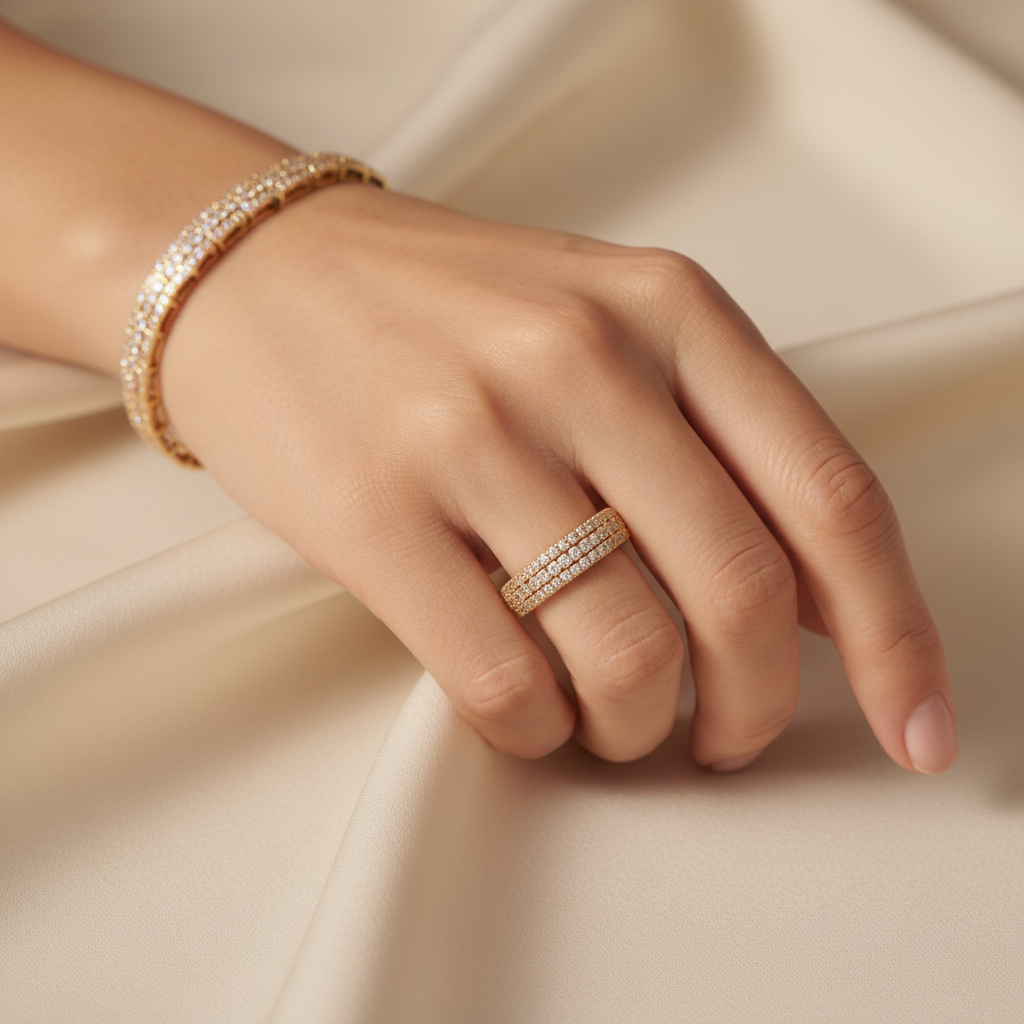
Finishing matters just as much. Clean edges and neatly shaped beads help the setting feel resolved. Polishing must be controlled, too, so that refining the surface does not remove metal needed for security. The finished effect may look effortless, but it rests on a sequence of deliberate decisions.
Natural Diamonds, Chosen for Their Role
A pavé diamond is small, but its contribution is not incidental. Careful selection for compatible dimensions, color appearance, and cutting helps a row read coherently. The goal is not to make every stone indistinguishable under all conditions, but to create a balanced visual whole.
For a principal natural diamond, a GIA grading report provides an independent record of assessed characteristics. The small diamonds used in pavé, often called melee, are generally not accompanied by individual GIA grading reports. Their selection and matching require a different level of practical attention at the bench; a center stone’s report does not describe the surrounding pavé.
Every UDE Collection design can also be made with lab-grown diamonds on request.
Designed for Life Beyond the Bench
Pavé invites a considered relationship with daily wear. A slim row can be beautifully wearable, but its tiny securing points deserve care. Remove pavé jewelry before lifting weights, gardening, or other activities that expose it to pressure, abrasion, or impact.
Gentle cleaning with warm water, mild soap, and a soft brush can help preserve its appearance. Professional inspection is important, particularly if a stone seems to move or an edge begins catching on fabric. Ask your jeweler before using an ultrasonic cleaner.
Placement also matters. Pavé extending around an entire band can complicate future resizing, making fit and long-term wear worth discussing early in the design process.
The pleasure of hand-set pavé lies in this meeting of delicacy and discipline: small natural diamonds, carefully supported, making light visible through skilled work. To explore the details in person, we warmly invite you to book an appointment at UDE Collection, Monday–Friday, 10am–6pm PST, by appointment.